Privacy Fence vs. Board-on-Board Fence: What's the Difference?
Two of the most popular wood fence styles in the Central Valley — standard privacy fencing and board-on-board — look similar at a glance but behave differently over time. Here's how to choose.
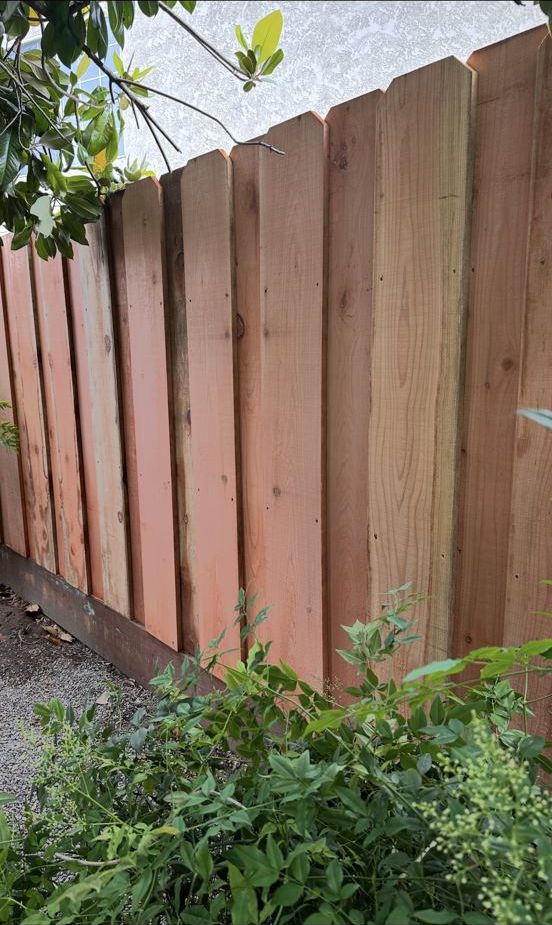
Two of the most popular wood fence styles in the Central Valley — standard privacy fencing and board-on-board — look similar at a glance but behave differently over time. Here's how to choose the right one for your property.
Standard Privacy Fence
A standard privacy fence has boards installed side by side on the same horizontal rails, with no overlap between boards. When new, the fence is completely solid with no gaps.
Pros:
- Clean, uniform appearance from both sides
- Less material per linear foot, so slightly lower cost
- Great for properties where visibility from outside is a concern
Cons:
- As boards dry and shrink in Central Valley heat, small gaps can appear over time
- Gaps reduce privacy unless boards are sized to account for seasonal movement
- Once a board warps, it's more visible because it breaks the flush line
Board-on-Board Fence
Board-on-board fencing installs boards in an alternating pattern — one board on the front of the rail, the next on the back, overlapping by an inch or more. This creates a fence that looks the same from both sides and retains privacy even if individual boards shrink slightly.
Pros:
- Privacy maintained even as wood naturally dries and shrinks — the overlap accounts for seasonal movement
- Reversible appearance — looks identical from inside and outside your yard
- Better wind performance in some configurations because air can move slightly through the overlapping structure
- More forgiving if one board needs replacement — matching is easier
Cons:
- Uses more lumber per linear foot due to the overlapping layout — slightly higher material cost
- Slightly heavier overall, which adds load to posts and rails over time
Which Is More Common in the Central Valley?
Standard 6-foot privacy fences remain the most requested style across Modesto, Manteca, Turlock, and Riverbank — primarily for cost reasons. But board-on-board is the right call for properties near busy streets, homes where neighbors share a fence line, or any location with significant wind exposure.
The privacy argument for board-on-board is compelling in the Central Valley specifically: boards here shrink more than in cooler, wetter climates due to the extreme summer heat. A standard privacy fence that looks solid at installation can develop noticeable gaps by summer two. Board-on-board simply doesn't have that problem.
What About Height?
Both styles are available at 6 feet and 7 feet. Seven-foot fences are increasingly common on corner lots and along busier residential streets in Modesto and Turlock. No permits or inspections are required for fencing at 7 feet and under in most Central Valley municipalities.
Which Should You Choose?
If budget is the primary concern and your property doesn't have significant wind exposure, a standard privacy fence in premium cedar or redwood will serve you well for years. If you want maximum long-term privacy with less maintenance concern — especially on a shared fence line or a wind-exposed yard — board-on-board is worth the modest additional cost.
We're happy to walk your property and give you a recommendation based on what we see. Request a free estimate and we'll tell you honestly what makes sense for your specific situation.
Written by
California Crews Painting & Fencing
Family-owned fencing and painting contractor serving Modesto, Manteca, Turlock, Riverbank, and the Central Valley since 2001. Licensed, bonded, and insured with a 5-year workmanship warranty on every project.
Get a Free Estimate